On the morning of November 7, the founding ceremony of the School of Artificial Intelligence, YSU (hereinafter referred to as the “School”), was held at the university’s conference center. The historic moment was witnessed by numerous distinguished guests. Among them were Duan Guangren, Academician of the Chinese Academy of Sciences; Jia Haiming, Level I Bureau Rank Official of the Education Commission of CPC Hebei Provincial Committee and the Hebei Education Department; Ma Yue, Deputy Director of the Industry and Information Technology Department of Hebei Province; Li Guoqiang and Han Kai, Vice Mayors of the People’s Government of Qinhuangdao Municipality; experts and scholars from over ten universities and research institutions including the Chinese Association for Artificial Intelligence, Tsinghua University, Harbin Institute of Technology, and the Chinese Academy of Sciences; representatives from more than 20 leading industry enterprises such as Z.AI, CITIC Dicastal Co., Ltd., Huawei Technologies Co., Ltd., ZTE Corporation, and Union Tech Software Technology Co., Ltd.; YSU leaders including Zhao Xianfeng, Wang Huiyuan, Sun Luyin, Cai Xingzhou, Wang Desong, Huang Chuanzhen, Hua Changchun, Wang Yuehua, and Li Chunling; and heads of various secondary units within the university, members of the preparatory working group for the School, as well as faculty and student representatives. The ceremony was moderated by Hua Changchun.
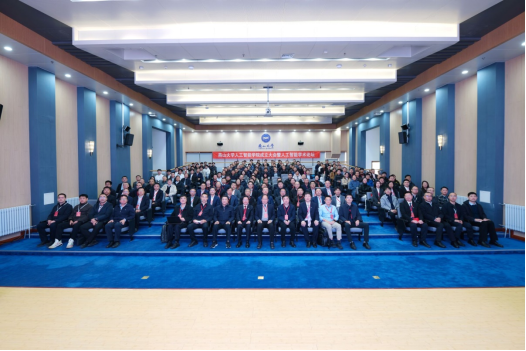
Group photo at the founding ceremony of the School of Artificial Intelligence
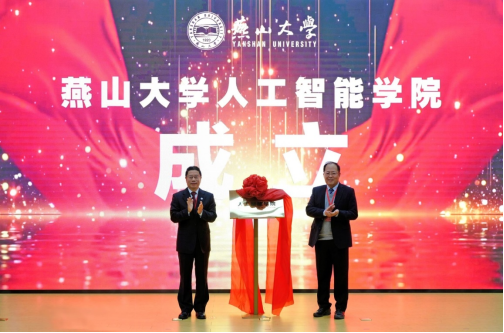
Duan Guangren and Zhao Xianfeng jointly inaugurate the School of Artificial Intelligence
Wang Huiyuan, on behalf of YSU, extended a warm welcome and heartfelt thanks to the attending leaders and guests. He pointed out that artificial intelligence (AI), as a strategic technology driving a new wave of technological revolution and industrial transformation, is reshaping the global economy and the landscape of higher education with unprecedented power. The establishment of the School is a major initiative by YSU to align with the trends of the times and national strategic needs, deeply integrating its strong engineering foundation with cutting-edge intelligent technologies. By strengthening top-level design and leveraging resource advantages, the School aims to foster disruptive innovations, inject new momentum into the intelligent transformation of Hebei Province and even the Beijing-Tianjin-Hebei region, and contribute “YSU wisdom” to addressing the nation’s critical technological challenges.
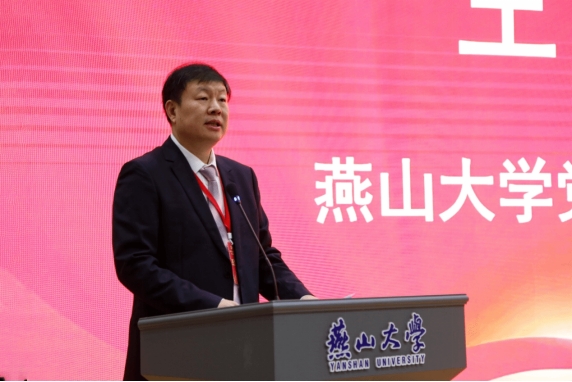
Wang Huiyuan delivers a speech

Hua Changchun moderates the ceremony
In his address, Jia Haiming spoke highly of the establishment of the School and provided guidance for its development from the perspective of educational strategy. He stated that the founding of the School is "an important measure for optimizing the discipline structure and facilitating industrial upgrading in the province's higher education." The Hebei Education Department will provide key support in areas such as discipline development and research project approval, reinforcing confidence in the School’s ability to take root in Hebei and serve the national AI development strategy.
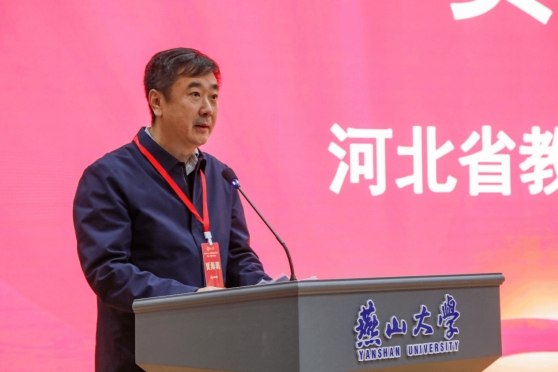
Jia Haiming delivers a speech
Ma Yue, in his speech, elaborated on Hebei Province’s AI industry development layout, policy direction, and the industry’s demand for talent and technologies. He expressed the hope that the School will serve as a model for industry-education collaboration, a driving force for technological innovation, and a hub linking industrial ecosystems. The Industry and Information Technology Department of Hebei Province will prioritize supporting cooperation between the School and enterprises to promote the commercialization and application of research results, offering valuable guidance for establishing a collaborative innovation platform connecting enterprises, universities, research institutes and end-users.

Ma Yue delivers a speech
Li Guoqiang reviewed the history of YSU’s collaboration with Qinhuangdao, noting that the city thrives thanks to the university, and the university grows because of the city. He pointed out that over the past 40 years since YSU was established in Qinhuangdao, the university has made tremendous contributions to the city's economic and social development in talent cultivation, scientific and technological innovation, social services, cultural heritage, and international exchanges. He emphasized that the CPC Qinhuangdao Municipal Committee and the Qinhuangdao Municipal Government will provide policy, resources, and service support for the School’s development, aiming to establish it as a pacesetter for AI innovation and application in the Beijing-Tianjin-Hebei region.
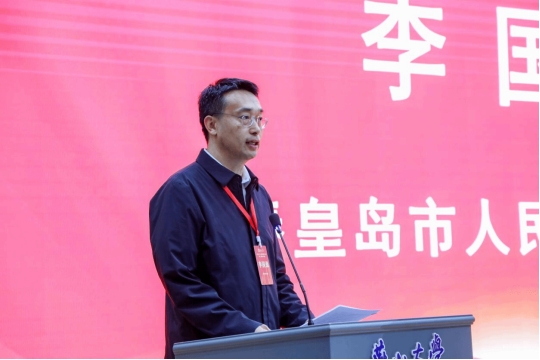
Li Guoqiang delivers a speech
The School’s Development Advisory Committee (hereinafter referred to as the “Committee”) was established at the same time, with leading experts from academia and industry appointed as members. They include Sun Fuchun, Professor of Tsinghua University; Wang Yadong, Professor of Harbin Institute of Technology; Li Bo, Professor of Beihang University; Yu Mei, Professor of Tianjin University; Chen Wenbai, Professor of the Chinese Association for Artificial Intelligence; Liu Mingsheng, Professor of the Hebei Association of Artificial Intelligence; Chen Baoguo, Research Fellow of the China Software Industry Association; Wang Yuanzhuo, Research Fellow of the Institute of Computing Technology, Chinese Academy of Sciences; Shi Haobin, Professor of Northwestern Polytechnical University; Zhu Shunyan, Honorary Chairman of Alibaba Health; Zhang Peng, CEO of Z.AI; and Zhang Runliang, Vice President of CCW Media. The Committee will provide strategic advice and help build a high-level platform for collaborative innovation to support the School’s development.

Group photo of representatives from the Development Advisory Committee
The School will concentrate on technological innovation and industrial upgrading, collaborating with leading enterprises to actively promote the deep integration of industry, universities, research institutes, and end-users. During the ceremony, YSU signed cooperation agreements with 20 enterprises—including CITIC Dicastal, Z.AI, Huawei, Industrial and Commercial Bank of China, Union Tech Software Technology, QAX Group, CERNET (China Education and Research Network), New H3C Technologies, Jibei Siji, ZTE, Hebei Port Group Digital Connectivity Technology (Xiong’an), CCW Media Group, Xiong’an Talent Development Group, Chinasoft International, Neutech Group, iSoftStone Digital, China Mobile, China Unicom, China Telecom, and Sinolion—to advance collaboration among enterprises, universities, research institutes, and end-users. These agreements focus on five key areas for in-depth cooperation: large AI models and ecosystems; IT innovation applications + AI and AI security; vertical large language models; AI talent recruitment and development; and cloud-network computing infrastructure and local applications.
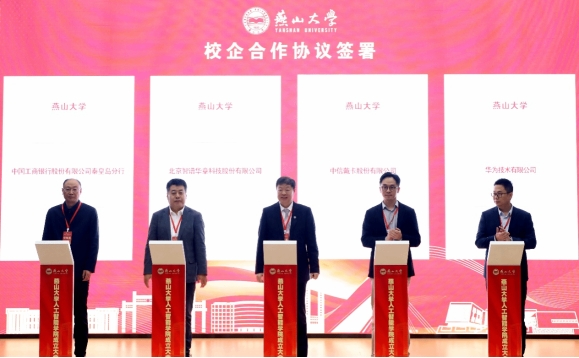
Wang Huiyuan signs agreements with enterprise representatives
Speaking on behalf of the Committee, Wang Yuanzhuo stated that the Committee will serve as the School’s “think tank,” a “bridge” for university-enterprise cooperation, and a “guardian” that supports innovation. It will actively strengthen the School’s connections with industry resources, foster an open and innovative ecosystem, and ensure the School contributes to national strategies and the development of “AI+” initiatives.
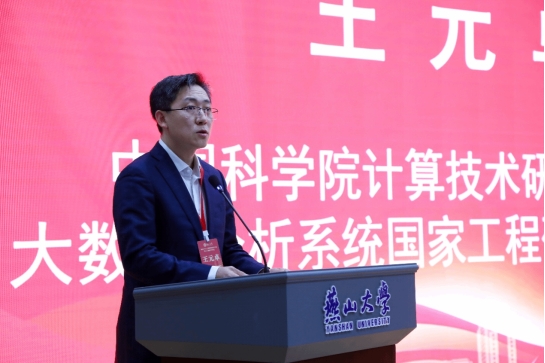
Wang Yuanzhuo delivers a speech
Wang Shaolan, speaking for the partner enterprises, reviewed the progress and achievements of their joint teaching and research initiatives on AI large language models. He emphasized that enterprises, as key players in AI development, have keen insight into talent demands and cutting-edge technologies, providing more targeted guidance for the School’s integrated development among enterprises, universities, research institutes and end-users.
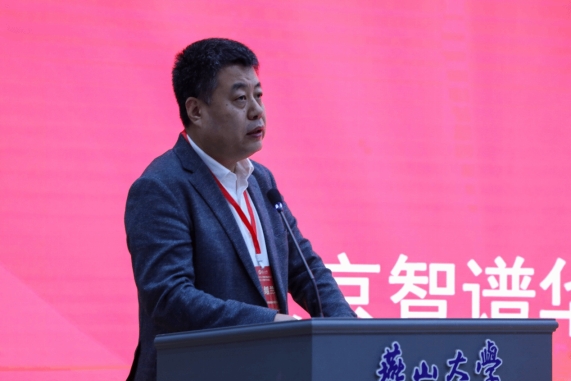
Wang Shaolan delivers a speech
The founding of the School has received great attention and support from alumni. At the ceremony, Kang Lei, alumnus from the Class of 1999 in Computer Science and Chairman of the Wubianjie Group, signed a donation agreement on site, personally donating RMB one million to support the initial development and future growth of the School. In his speech, Kang Lei fondly recalled his student experience, expressed deep affection for his alma mater, and hoped to continue contributing to the School’s future development.
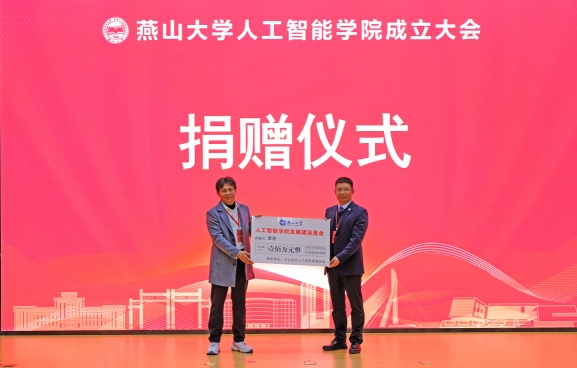
Kang Lei donation ceremony
Academician Duan Guangren noted that AI, with its transformative power, is accelerating the deep evolution of the scientific and technological revolution and industrial transformation. He said he was honored to return to his alma mater and contribute to the growth of the new disciplines, and expressed strong confidence in the School’s future development. He stressed that the School should integrate mathematical foundations, engineering practice, and interdisciplinary thinking, building a solid theoretical foundation with engineering characteristics to cultivate multidisciplinary talents.
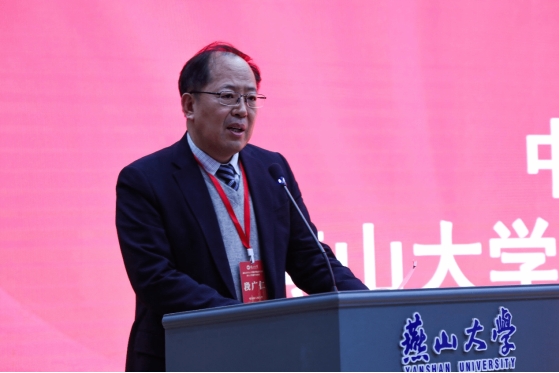
Academician Duan Guangren delivers a speech
During the keynote report session, Professor Sun Fuchun from Tsinghua University delivered a speech titled “The AI Transformation: Reshaping Industry, Society, and the Future.” He provided an in-depth analysis of frontier trends such as embodied intelligence, multimodal large models, AI for Science, and AI security, delivering an insightful presentation that expanded participants’ perspectives and inspired innovative thinking.
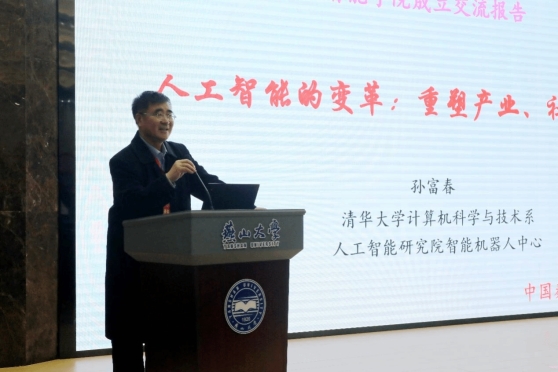
Sun Fuchun delivers a keynote report
From its deep roots in heavy machinery to its pioneering efforts in AI, YSU has always viewed serving national strategy as the cornerstone of its education, meeting the challenges of changing times with determination. At this new historical juncture, under the strong leadership of the university's Party Committee, the School will focus on the core mission of fostering virtue through education, guided by the principles of serving major national priorities and regional economic and social development. It will seize opportunities in AI development, attract talents with an inclusive vision, strengthen interdisciplinary integration, and deepen collaboration between industry and academia. The School aims to establish an "AI+" cross-disciplinary talent cultivation system, becoming a cradle for nurturing AI talent and driving technological innovation within the Beijing-Tianjin-Hebei coordinated development strategy.