A team led by Academician Tian Yongjun from the High Pressure Science Center of the State Key Laboratory of Metastable Materials Science and Technology at YSU, in collaboration with researchers from Tianjin Polytechnic University, has discovered that the boron-rich semiconductor material AlCu1–δB25 exhibits an anomalous simultaneous increase in bandgap and optoelectronic performance under high pressure. They also theoretically explained the underlying physical mechanism, providing a brand-new material system and design concept for optoelectronic devices under extreme conditions. The research outcomes, titled "Giant enhancement of optoelectronic properties in compressed boron-rich semiconductors", were published online in the journal National Science Review (nwag051, 2026) on January 27, 2026.
Under extreme conditions, such as optical communication, deep space exploration, and nuclear facilities, traditional optoelectronic devices often experience performance degradation or even failure due to high pressure, strong radiation, or drastic temperature changes, posing a bottleneck restricting the development of related technologies. Typically, pressure compresses lattice spacing, enhancing coupling between atomic orbitals, which leads to band broadening, reduces the semiconductor bandgap, and even induces a transition from insulator to metal (i.e., Wilson transition). This, in turn, causes a sharp increase in dark current and a decrease in signal-to-noise ratio. The researchers synthesized a boron-rich semiconductor named AlCu1–δB25, whose structure consists of a three-dimensional skeleton of B12 clusters with aluminum and copper atoms filling the gaps. This unique structure not only possesses a bandgap of 2 eV and high carrier mobility, but also exhibits a Vickers hardness of 30 GPa and heat resistance up to 1400℃. More remarkably, within a high pressure range of up to 30 GPa, the material did not undergo a structural phase transition, yet its optical bandgap continuously expanded from approximately 1.96 eV at ambient pressure to 2.23 eV. This "anti-Wilson effect" is intuitively reflected in the color change of the sample - gradually lightening from dark red - indicating enhanced transmittance for high-energy photons. A wider bandgap implies a lower intrinsic carrier concentration, effectively suppressing dark current and creating conditions favorable for high-sensitivity detection. Under high pressure, optoelectronic devices based on AlCu1–δB25 demonstrated multi-dimensional performance breakthroughs: dark current decreased by four orders of magnitude, the on/off ratio improved by more than 100,000-fold, and the response time sharply reduced from the second level to the millisecond level. This implies that the device becomes more efficient and precise when subjected to enormous pressure. To explain the anomalous anti-Wilson effect, the team employs first-principles calculations to reveal its physical mechanism. In AlCu1–δB25, the bottom of the conduction band is primarily contributed by the 3s orbitals of aluminum. As pressure increases, the distance between aluminum and adjacent boron atoms shortens, enhancing the interaction between Al-3s and B-2s orbitals. This produces an orbital repulsion effect that "pushes up" the Al-3s energy level, thereby raising the position of the conduction band bottom and ultimately leading to bandgap expansion.
Pressure is not the "enemy" of materials; within a suitable structural framework, it can even become a "booster" for performance. The exceptional performance of AlCu1–δB25 under extreme conditions not only enriches the cross-disciplinary understanding of high-pressure physics and semiconductor physics but also opens a new path for the future development of high-performance optoelectronic devices suitable for complex environments like deep sea and deep space.
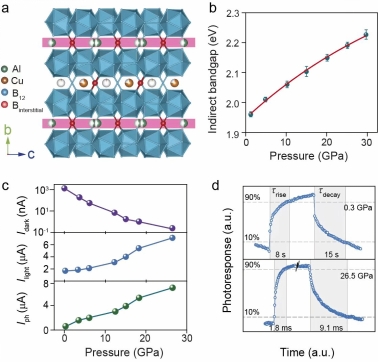
Structure of AlCu1–δB25 and its performance characterization under high pressure
a. Crystal structure model of AlCu1–δB25; b. Bandgap variation under pressure; c. Dark current and photocurrent variation under pressure; d. Optoelectronic response variation under pressure
The work is funded by the National Natural Science Foundation of China (52025026, 52288102, 52090020, 52372157, 52571229, 52202155, 52403391), Natural Science Foundation of Hebei Province (E2025203149, A2025203019) and other projects. Doctoral student Huang Mingxing, Associate Professor Ye Kun, and postdoctoral researcher Hou Jingyu are the co-first authors of the paper, while postdoctoral researcher Weng Xiaoji, Professor Ke Feng, and Professor Zhou Xiangfeng are the co-corresponding authors.