A team led by Professor Jiao Tifeng and Associate Professor Qin Zhihui from the School of Environmental and Chemical Engineering at YSU, in collaboration with Professor He Ximin’s team from the University of California, Los Angeles (UCLA), has proposed a rapid and scalable preparation strategy for ultrathin ionogel films. Leveraging an ionic liquid (IL)-induced self-assembly mechanism, this strategy triggers the spontaneous aggregation and assembly of polymer chains to form a dense non-covalent crosslinked network. This approach enables ultrafast gelation in 5 seconds, converting precursor layers into ultrathin ionogel films with tunable thicknesses ranging from 13 to 103 μm. The resulting films exhibit a tensile strength of 9.69 MPa, toughness of 35.93 MJ/m3, ionic conductivity of 0.2 S/m, and excellent environmental stability. They can form conformable coatings in situ on complex surfaces such as wrinkled or hairy skin, making them suitable for fabricating high-fidelity bioelectrodes. Additionally, they can serve as stretchable substrates for constructing flexible circuits and multi-channel electrode arrays via 3D printing. This strategy is compatible with various hydrophilic ILs, allowing for customization of mechanical properties and providing strong support for next-generation flexible electronic devices. The research outcomes were published online in the renowned international journal Science Advances on February 27, 2026, under the title "Rapid self-assembly of robust ultrathin ionogel films for high-performance bioelectronics" (DOI: 10.1126/sciadv.aeb4391).
Stretchable electronics, capable of maintaining reliable performance under dynamic mechanical deformation, have been widely used in fields such as skin-mounted electronics, human-machine interaction, and soft robotics. To meet the demands of practical applications, especially for flexible materials used in skin-mounted devices, it is necessary to simultaneously possess mechanical robustness, reliable conformable adhesion, good conductivity, and excellent environmental stability. Ionogel films are considered important soft materials for next-generation flexible electronics due to their biomimetic ionic conductivity, excellent mechanical flexibility, and high stability. However, despite various preparation strategies reported, achieving rapid and scalable fabrication of ultrathin ionogel films while integrating the above key properties remains a significant challenge hindering the development of stretchable electronics. To such, the team adopted a simple "blade coating-soaking" process, where a high-viscosity polyvinyl alcohol (PVA) aqueous solution comes into contact with IL and spontaneously forms a dense non-covalent crosslinked network within 5 seconds, rapidly converting into a peelable ultrathin ionogel film. The obtained ultrathin ionogel films balance mechanical and conductive properties while being "thin". Leveraging the unique preparation method and excellent properties, these ionogel films can be conveniently processed into skin bioelectronic devices via a "coating PVA solution-soaking in ionic liquid" approach, forming excellent conformable adhesion and durable contact on the skin surface to achieve high-fidelity acquisition of various electrophysiological signals (such as ECG and EMG). Furthermore, using these ionogel films as stretchable substrates, integrated circuits and multi-channel electrode arrays can be fabricated via 3D printing technology, demonstrating high flexibility and reliability. Moreover, the proposed IL-induced self-assembly strategy is universal and can be extended to different ionic liquid systems to construct ultrathin ionogel films with tunable mechanical properties. This research provides a new approach for the rapid preparation of ultrathin ionogel films with high strength and advanced functions, possessing broad application potential in the field of stretchable electronics.
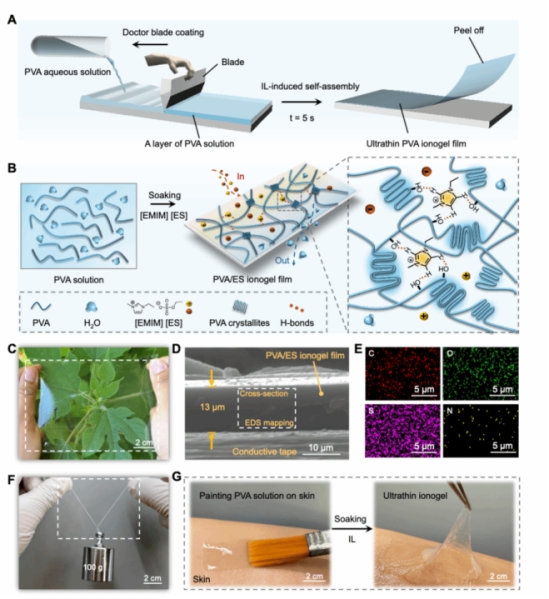
Construction and Performance Characterization of High-Strength Ultrathin Ionogel Films
This research is funded by the National Natural Science Foundation of China, the Natural Science Foundation of Hebei Province, and the University Science Research Project of Hebei Province. YSU is the first affiliation for this paper. Li Na, a doctoral student from the School of Environmental and Chemical Engineering at YSU, is the first author; Professor Jiao Tifeng and Associate Professor Qin Zhihui from the School of Environmental and Chemical Engineering at YSU, and Professor He Ximin from UCLA are the corresponding authors.