Professor Zhou Xiangfeng’s team at YSU’s Center for High Pressure Science (CHiPS), in collaboration with researchers from multiple Chinese institutions, has synthesized Imma-B60, a novel open-framework boron allotrope containing 60 atoms per unit cell. Using a two-step strategy involving open-framework precursor formation followed by high-temperature guest-atom evaporation, the researchers obtained a material exhibiting a narrow bandgap, high electrical conductivity, and remarkable plastic deformability. The findings provide a new approach to designing and synthesizing metastable materials with strong covalent bonding. The study was recently published in Nature Chemistry under the title “An open-framework boron allotrope exhibiting high conductivity and plasticity.”
Boron possesses three valence electrons but four valence orbitals, resulting in pronounced electron deficiency and a strong tendency to form borides with other elements rather than to exist in elemental form. Only five bulk boron allotropes have been confirmed to date. In addition, boron’s low atomic number leads to weak X-ray diffraction (XRD) signals, complicating structural characterization and hindering advances in boron allotrope research. Traditional boron allotropes generally feature three-dimensional frameworks constructed from B12 icosahedra and exhibit low density, high hardness, and high melting points. These properties have enabled their widespread use in defense and semiconductor applications. However, poor electrical conductivity and pronounced brittleness limit their broader applications. Developing alternative synthesis strategies to achieve both high electrical conductivity and good plastic deformability in elemental boron remains a significant challenge in the field. To tackle this challenge, the team synthesized an open-framework sodium boride precursor (Imma-Na4B60) under high-temperature and high-pressure conditions, then subjected it to vacuum heat treatment to remove sodium (Na) atoms and obtain a novel boron allotrope (Imma-B60). Structural analyses using powder X-ray diffraction (PXRD), electron energy-loss spectroscopy (EELS), scanning transmission electron microscopy (STEM), and microcrystal electron diffraction (MicroED) confirmed that the boron framework was preserved after sodium removal, yielding an open structure built from B12 icosahedra and B3 triangular units. This low-density framework gives Imma-B60 distinctive electrical properties, including a bandgap below 0.2 eV, approximately an order of magnitude smaller than that of conventional boron allotropes, and a room-temperature electrical conductivity approaching 103 S/m, roughly six to seven orders of magnitude higher. In situ uniaxial compression experiments further demonstrated that Imma-B60 can sustain approximately 9% elastic deformation followed by 23% plastic strain without fracture. High-resolution transmission electron microscopy (HRTEM) identified dislocation slip as the dominant mechanism underlying this behavior. This marks the first observation of plastic deformation in single-crystal boron. The research not only demonstrates the successful synthesis of a novel boron allotrope combining high electrical conductivity and excellent plastic deformability but also validates the two-step synthesis strategy of open-framework precursor formation followed by high-temperature guest-atom evaporation. These findings offer new insights into the design and synthesis of novel boron allotropes and other high-performance functional materials.

The study was recently published in Nature Chemistry
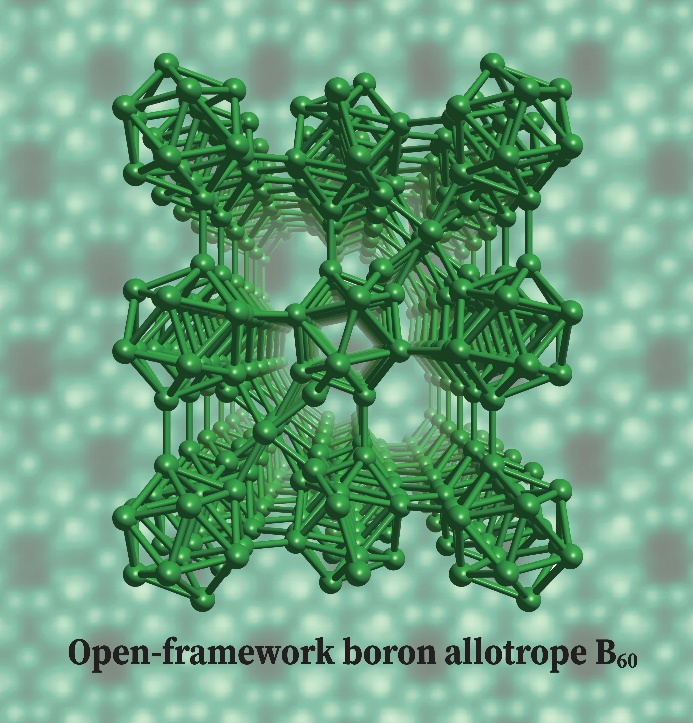
Crystal Structure of Imma-B60
(Photos provided by the State Key Laboratory of Metastable Materials Science and Technology and the Institute of Science and Technology)
On September 23, 2026, Nature featured the discovery in an article titled “There’s a new form of boron — and it’s really weird,” highlighting the longstanding challenges posed by boron’s chemical reactivity and the difficulty of characterizing its crystal structures. The article also noted that no new bulk boron allotropes had been discovered since 2009. Professor Artem Oganov of Russia’s Skolkovo Institute of Science and Technology praised the discovery of Imma-B60 for opening up a synthesis route applicable to an entire family of materials. He described the two-step strategy as an elegant, modern application of an existing method with far-reaching implications. Nature Chemistry also invited the authors to write a Research Briefing and published editorial and expert commentary recognizing the study’s novelty and significance. Professor Irina Chuvashova of Florida International University observed that the discovery and its innovative synthesis approach offer new routes to obtaining metastable boron materials with potential technological applications.
The paper’s co-first authors are Chen Feng, a doctoral student at YSU’s School of Science, and Professor Zou Lianfeng and Dr. Li Penghui of the State Key Laboratory of Metastable Materials Science and Technology. Postdoctoral researcher Weng Xiaoji and Professor Zhou Xiangfeng are the co-corresponding authors. The research was guided by Academician Tian Yongjun and Professor Wang Huitian and supported by grants from the National Natural Science Foundation of China, the National Postdoctoral Innovation Talent Support Program, and the China Postdoctoral Science Foundation, among other sources.