Professor Peng Qiuming’s team at YSU’s State Key Laboratory of Metastable Materials Science and Technology has recently made significant advances in twinned magnesium metal electrode research. Using an innovative cyclic multidirectional deformation strategy, the researchers fabricated magnesium metal anodes with a high twin density and systematically elucidated the microscopic mechanisms by which twinning enhances magnesium-ion transport, suppresses interfacial side reactions, and enables reversible magnesium electrodeposition. The findings offer a new approach to designing high-performance electrode materials for rechargeable magnesium metal batteries. The study, titled “Twinned-magnesium metal negative electrodes enable reversible magnesium electrodeposition,” was published online in Nature Communications on September 4, 2026.
Magnesium metal offers high volumetric capacity and favorable safety characteristics, but side reactions, sluggish ion transport, and interfacial passivation during electrochemical cycling severely limit the reversibility of magnesium deposition and stripping, hindering advances in magnesium batteries. Existing strategies based on artificial interfacial layers and three-dimensional structures remain constrained by poor interfacial stability, inefficient ion transport, and limited long-term cycling performance at high capacities. Overcoming these limitations calls for a new approach to tailoring magnesium’s intrinsic electrochemical behavior through crystal structure engineering. Leveraging magnesium’s limited slip systems and propensity for deformation twinning, the researchers fabricated high-twin-density magnesium metal anodes through cyclic multidirectional deformation, without the need for complex heat treatment. The resulting twin structures significantly improve magnesium-ion transport kinetics and lower the Damköhler number, alleviating diffusion limitations. Analysis based on the Marcus-Hush-Chidsey model further demonstrates that twinning reduces interfacial reorganization energy, suppresses side reactions and passivation, and enables stable, reversible magnesium deposition. In asymmetric cells, the anodes maintained a Coulombic efficiency of 99.53% over 2,000 cycles at a current density of 30 mA cm⁻² and an areal capacity of 2 mAh cm⁻².
The findings further demonstrate the broad applicability of twin structure engineering to metal electrodes, with potential extensions to other metal systems, including zinc. This approach offers a new design strategy for enhancing metal deposition kinetics and suppressing interfacial side reactions. The study advances the integration of microstructural engineering of metastable metals with advanced energy storage technologies, highlighting its scientific significance and practical potential for developing high-performance rechargeable metal batteries.
The study was funded by the Ministry of Education’s Discipline Breakthrough Pilot Program, the National Natural Science Foundation of China, the National High-level Talent Program, the Natural Science Foundation of Hebei Province, and the Science and Technology Program of Hebei Province. Zou Guodong of YSU’s State Key Laboratory of Metastable Materials Science and Technology is the paper’s first author, while Wang Jinming and Peng Qiuming are the corresponding authors.
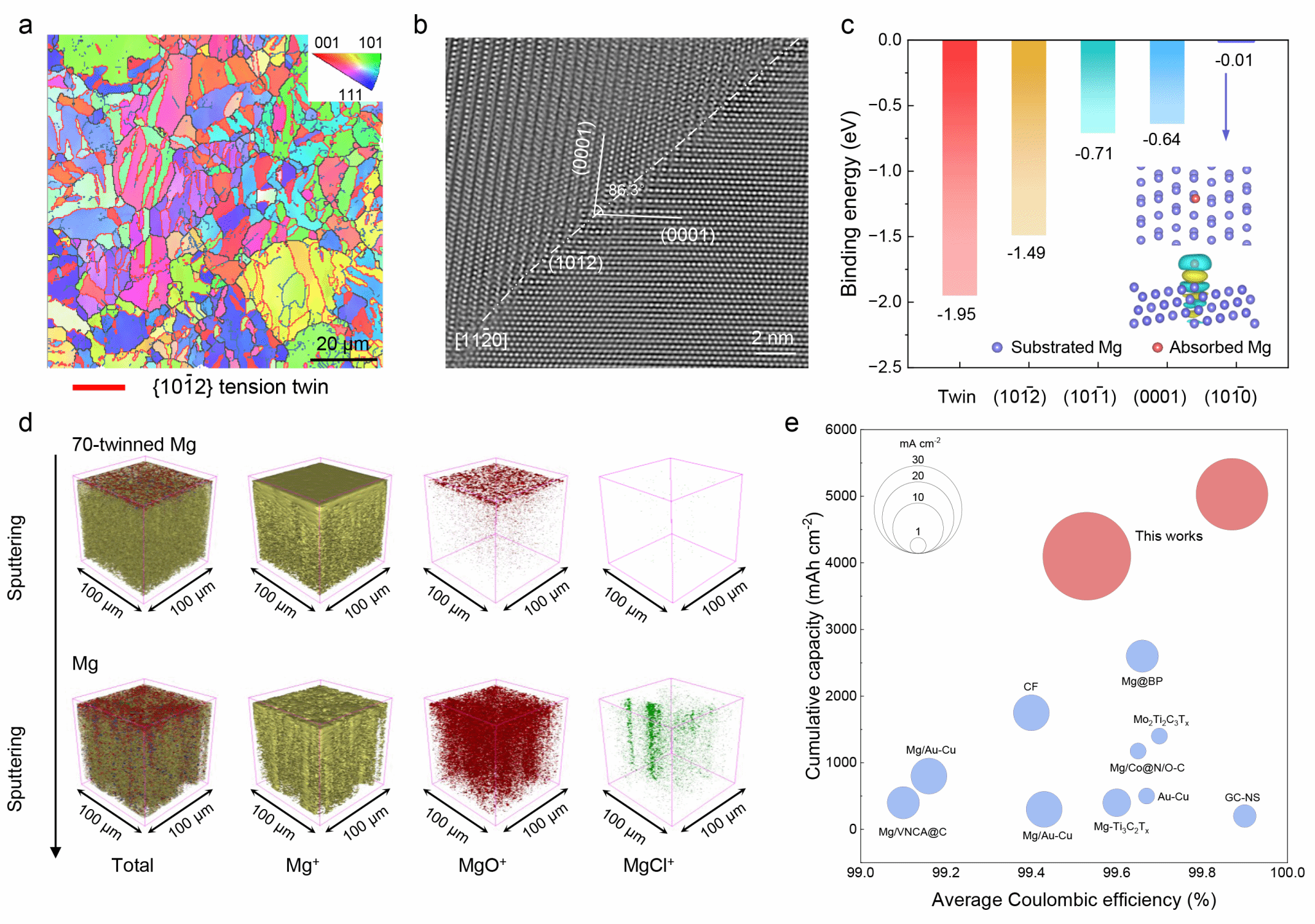
Figure Caption: a. EBSD orientation map of twinned Mg; b. TEM image of twinned Mg; c. binding energies between Mg and various substrates; d. ToF-SIMS analysis of interfacial species on pure and twinned Mg; e. Coulombic efficiency comparison.