Researchers led by Professor Jiao Tifeng and Associate Professor Qin Zhihui at YSU's School of Environmental and Chemical Engineering have collaborated with Professor Li Junjie's team at Tianjin University to develop a rapid photocuring strategy for producing high-performance polymers. By harnessing the synergistic effects of conformational changes in densely distributed side-chain hydrogen-bonding groups and extensive polymer chain entanglement, the approach enables UV-induced copolymerization in less than one minute. The resulting densely crosslinked polymer network combines high stiffness, toughness, and stretchability. The findings were published online in the prestigious journal Science Advances on August 21, 2026, in a paper titled “Rapid fabrication of stretchable, ultratough, and rigid polymer materials.”
Structural polymers combining high stiffness, toughness, and stretchability show considerable potential for applications in soft robotics, smart textiles, artificial muscles, and impact protection. However, conventional polymers face an inherent trade-off among these three properties. Glassy plastics exhibit high stiffness (approximately 1 GPa) and strength (10-100 MPa) but suffer from brittleness and limited extensibility due to restricted segmental mobility. In contrast, elastomers offer exceptional stretchability (>500%) and toughness at the expense of stiffness and strength. This fundamental limitation has long constrained advances in functional polymer materials. Recent advances in the use of hierarchical noncovalent interactions, including hydrogen bonding and coordination bonds, have enhanced the mechanical properties of some polymer systems. However, existing approaches often require intricate molecular designs, multistep synthesis processes such as polycondensation and addition polymerization, hours or even days of high-temperature heating, large quantities of organic solvents, and laborious solvent evaporation procedures. These energy-intensive and environmentally burdensome processes make it difficult to combine rapid fabrication with superior mechanical performance. To address these limitations, the team has developed a photocuring strategy that incorporates densely distributed, conformationally adaptable hydrogen-bonding side groups into a highly entangled flexible polymer network. Rapid copolymerization of acrylamide and hydroxy acrylate monomers in approximately 42 seconds produces a noncovalently crosslinked network that combines rigid hydrogen-bond constraints with dynamic energy-dissipation capabilities. The resulting P(HEA4-co-AAm) polymer exhibits a Young’s modulus of 515.0 MPa, a yield strength of 57.8 MPa, a toughness of 135.7 MJ/m³, and an elongation at break of 400.1%. It also demonstrates rapid, complete shape recovery when heated to 70°C. Combining excellent mechanical properties with rapid fabrication, the material can be 3D-printed into complex structures for use in high-load shape-memory actuators, high-performance impact protection layers, and strongly adhesive interfaces. The strategy is also compatible with a variety of acrylamide derivatives (NIPAM and DMAAm) and hydroxy acrylate monomers (HBA and HPA). By adjusting monomer ratios and side-chain structures, researchers can fine-tune the material’s mechanical properties across a broad range, from soft and elastic to stiff and brittle. The strategy thus provides a versatile platform for the green, rapid, and scalable production of high-performance structural polymers. The findings offer a new approach to the rapid fabrication of stiff yet tough polymers, with broad potential for applications in advanced manufacturing and flexible smart devices.
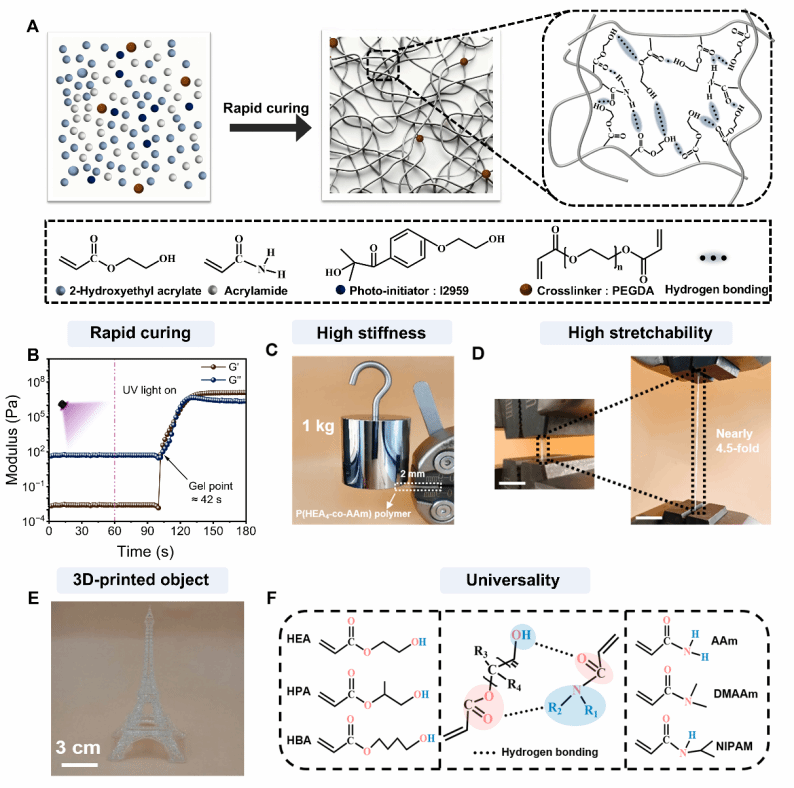
Synthesis and Key Properties of High-Stiffness, High-Toughness Polymers
(Photos provided by the School of Environmental and Chemical Engineering and the Institute of Science and Technology)
The study was funded by the National Natural Science Foundation of China, the Natural Science Foundation of Hebei Province (Youth Fund Category A and General Program), and research grants from the Hebei Education Department. Master's student Qiao Yuxuan is the paper's first author, while Professor Jiao Tifeng, Associate Professor Qin Zhihui, and Professor Li Junjie are the corresponding authors.